Review of Xiaomi Redmi 13 5G
Manish Kumar Rai
ResaleGrid India Contributor
The Xiaomi Redmi 13 5G features a large 6.79″ FHD+ IPS LCD display with 120Hz adaptive refresh rate and Gorilla Glass 3 protection. It launched in mid-2024 in India at ₹13,999 (6GB/128GB) and ₹15,499 (8GB/128GB). Out of the box it runs Android 14 with Xiaomi’s new HyperOS, offering up to 16GB total RAM (8GB + 8GB virtual RAM) for smooth multitasking. This budget 5G phone packs a surprising set of features – a crystal-glass dual-panel body, a high-resolution 108 MP camera, and solid battery life – making it a strong contender in its price range.
Design & Display
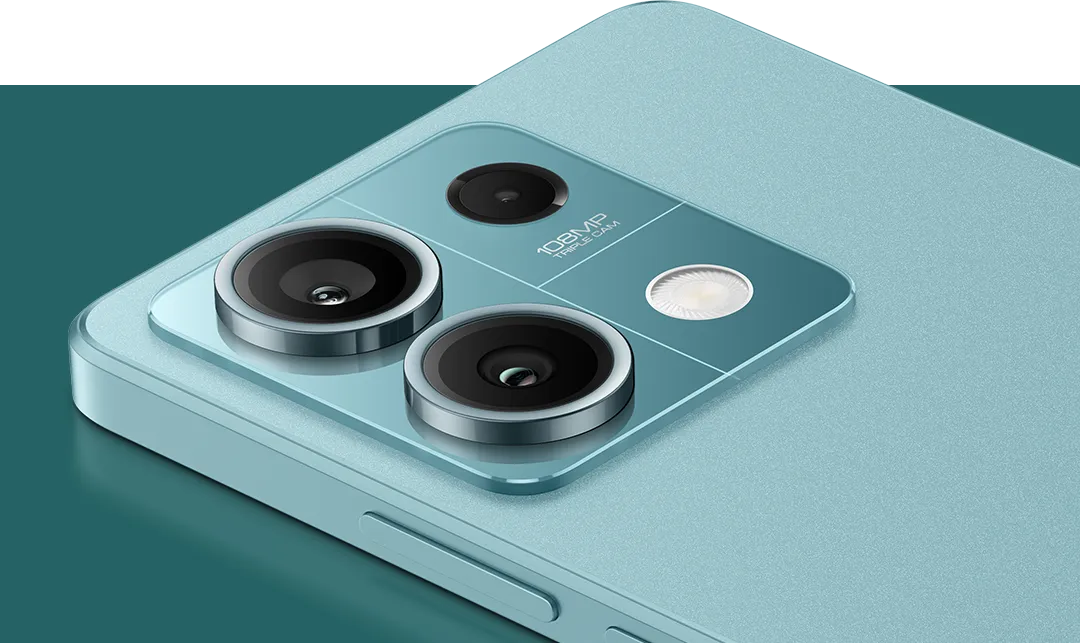
The back of the Redmi 13 5G highlights its premium “Crystal Glass” design and a unique circular ring LED flash around the dual camera module. The phone’s body has a glass front and back (a rare feature in this segment), with an IP53 rating for dust/splash resistance. We found the build quality surprisingly upscale: the wave-like patterns on the Hawaiian Blue rear look very polished and catch light at different angles. In hand it feels substantial (about 205 g) but well-balanced, and it still includes handy extras like a 3.5 mm headphone jack, IR blaster, and side-mounted fingerprint scanner.
The Redmi 13 5G sports a massive 6.79-inch IPS LCD screen at FHD+ (1080×2460) resolution. The panel supports AdaptiveSync up to 120 Hz, meaning it can switch refresh rates (30–120 Hz) depending on the content to save power. In practice this makes scrolling and animations very smooth. The display is bright and colorful, but peak outdoor brightness is around 550 nits, so direct sunlight can still wash out the image somewhat. Gorilla Glass 3 provides basic protection against scratches. Overall, the screen is excellent for multimedia and gaming at this price, even if it’s not quite as vivid as AMOLED.
Performance & Software
Inside, the Redmi 13 5G uses Qualcomm’s Snapdragon 4 Gen 2 (4 nm fabrication) – an octa-core chipset with two 2.3 GHz Cortex‑A78 “performance” cores and six 2.0 GHz Cortex‑A55 efficiency cores. This is a modest but modern chipset for the sub‑₹15K category. In benchmarks it scores about 445,000 on AnTuTu, placing it ahead of many earlier budget phones. Day-to-day performance is smooth: apps launch quickly and the 120 Hz UI feels responsive. The GPU (Adreno 613) can handle casual gaming well, though intensive 3D games will push it (we observed about 8% battery drop and 27% temperature rise after 30 min of gaming).
The phone comes with 6 GB or 8 GB of LPDDR4X RAM (plus 8 GB virtual RAM expansion) and 128 GB UFS 2.2 storage (expandable via microSD). In our experience, 8 GB RAM feels sufficient for multitasking, and the virtual RAM bump (up to 16 GB total) helps for heavy workloads. Xiaomi’s new HyperOS (built on Android 14) runs on it. HyperOS is clean and buttery smooth at 120 Hz, though it does ship with some pre-installed third‑party apps (which can be uninstalled). You also get two years of OS updates and four years of security patches promised. Overall, performance is “very good” for its class – more than enough for social media, video, even modest gaming, as noted in reviews.
Camera
The Redmi 13 5G has a dual rear camera setup: a 108 MP main sensor (Samsung ISOCELL HM6) with f/1.75 aperture, 1/1.67″ size, and 0.64 µm pixels, plus a 2 MP macro/depth sensor. The signature feature is the ring-shaped LED flash around the cameras, which can also work as an auxiliary flashlight or notification light. For everyday photography, the 108 MP shooter captures very sharp, detailed images in good daylight. Colors are vivid and exposure is generally accurate, thanks to the high resolution and an included HDR mode. The f/1.75 aperture and bright sensor help, and the in-sensor 3x zoom can crop photos without much quality loss.
However, low-light performance is merely average. You do get Night Mode, and the ring flash does help illuminate subjects, but noise and softness creep in under dim lighting. The 2 MP secondary camera offers very limited use (it’s primarily for macro/extra depth data), so most shots rely on the main camera’s crop. Video can be recorded up to 1080p@30fps on both rear and front. Speaking of front, the 13 MP selfie camera (f/2.45) does a decent job for its class. Selfies have natural colors and enough detail in good light, though night selfies require screen-flash help. Overall, the camera excels in daylight thanks to that huge 108 MP sensor, but falls back to average territory in the dark.
Battery & Charging
With a 5030 mAh battery, the Redmi 13 5G easily lasts a full day of mixed use. In our testing, it scored about 14 hours on the PCMark battery test – roughly on par with competitors. In real life, we routinely got a day and a half with moderate use (web, video, a bit of gaming). When you do need a charge, the phone supports 33W TurboCharge, and Xiaomi includes a 33W charger in the box. That delivers about 50% battery in ~30 minutes, and roughly 100% in about 1h15m. In our tests charging 20→100% took ~1.3 hours, which is fast for a budget device. Overall, battery life is a strong suit – it will easily power through a busy day, and you won’t mind plugging in a bit before bed.
Connectivity & Extras
The Redmi 13 5G is a dual-SIM (hybrid) smartphone with support for 5G, LTE, VoLTE, dual-band Wi-Fi, Bluetooth 5.4, GPS/GLONASS, and NFC (in some markets). It also retains useful legacy features: a 3.5 mm headphone jack, IR blaster (for TV/AC control), and FM radio support. Sensor-wise, it has the usual array (accelerometer, proximity, compass, gyro, etc.) and a side-mounted fingerprint scanner (fast and accurate).
One noteworthy inclusion is the long-term support: Xiaomi promises 2 OS updates and 4 years of security patches, plus a “36-month lag-free experience” claim from internal tests. While we can’t verify 3 years of smoothness, it suggests Xiaomi expects the phone to age gracefully if lightly used.
Specifications
| Feature | Specification |
|---|---|
| Display | 6.79″ IPS LCD (17.25 cm), 1080×2460 px (FHD+), AdaptiveSync 120 Hz, 396 ppi, Gorilla Glass 3 protection |
| Processor | Qualcomm Snapdragon 4 Gen 2 (4 nm) – Octa-core (2×2.3 GHz Cortex-A78 + 6×2.0 GHz Cortex-A55) |
| GPU | Adreno 613 |
| Memory (RAM) | 6 GB or 8 GB LPDDR4X (plus 8 GB virtual RAM, for up to 16 GB total) |
| Storage | 128 GB UFS 2.2 internal (hybrid slot), expandable via microSD up to 1 TB |
| Rear Camera | Dual: 108 MP (wide, f/1.75, Samsung S5KHM6, 1/1.67″, 3× in-sensor zoom) + 2 MP (macro/depth); Ring LED flash; Video: up to 1080p@30fps |
| Front Camera | 13 MP (wide, f/2.45); Video: 1080p@30fps |
| Battery | 5030 mAh Li-Polymer; 33W fast charging (50% in ~30 min) |
| OS / UI | Android 14 with MIUI’s new HyperOS; promised 2 major OS updates, 4 years security |
| Build | Dual-glass design (Corning Gorilla Glass 3 front/back), IP53 dust/splash resistance; side fingerprint scanner; 3.5 mm jack; IR blaster |
| Dimensions / Weight | 168.6×76.28×8.3 mm; ~205 g |
| Price (India) | ₹13,999 (6GB/128GB); ₹15,499 (8GB/128GB) |
Pros and Cons
| Pros | Cons |
|---|---|
| Large 120Hz FHD+ display (6.79″) for smooth scrolling and gaming | Moderate peak brightness (~550 nits) – can be hard to see in bright sun |
| Premium dual-glass build with IP53 dust/splash resistance | No stereo speakers (audio is mono) |
| Sharp 108 MP main camera (good daytime photos) | Low-light camera quality is only average (night shots can be noisy) |
| Capable Snapdragon 4 Gen 2 processor – smooth daily performance | Ships with some third-party bloatware/apps |
| Long battery life (5030 mAh) and fast 33W charging | – |
Who Should Buy Xiaomi Redmi 13 5G?
The Redmi 13 5G is aimed at budget-conscious users who want the bells and whistles of a more expensive phone. Smartphone photographers will like the huge 108 MP sensor and creative ring flash (great for daytime shots and fun lighting). Casual gamers and media users will appreciate the big 6.79″ 120Hz display and the solid Snapdragon 4 Gen 2 chip – it handles most games smoothly (at moderate settings) and makes scrolling/touch interaction fluid. Everyday users get a full day of battery and a clean Android experience with long-term software support.
However, if you prioritize audio or gaming performance, you might look elsewhere: the mono speaker lacks stereo depth, and the GPU isn’t flagship-level. Those needing best-in-class low-light photos should also note its limitations in the dark. In summary, the Redmi 13 5G is a great value 5G smartphone under ~₹15K: it’s especially well-suited for users who want a large display, smooth UI, and very detailed daylight photos on a tight budget.
Image Source: Visit Image Source